
"Efficient" gets thrown around loosely in appliance marketing, so it's worth actually tracing where the energy goes in each type of stovetop before deciding whether the claim holds up for induction. The short version: it does, and the reason is almost entirely about what doesn't get heated along the way.
Gas: most of the flame heats the room, not the pan
An open gas flame spreads out well beyond the base of the pan sitting on it. Anyone who's cooked with a pan smaller than the burner ring has seen the flame licking up the sides. That's energy heating the surrounding air and the outside of the pot rather than the food inside it. A meaningful share of the heat a gas burner produces never makes it into what you're cooking.
Electric coil: an extra step, an extra loss
An electric coil has to heat itself first, then transfer that heat to the pan through direct contact, and contact is never perfect. Warping, a slightly uneven pan base, or a coil that hasn't fully reached temperature all mean gaps where heat radiates uselessly into the air instead of the cookware. The coil also keeps radiating heat for a while after you turn the dial down, which is wasted energy you're not using for cooking.
Induction: the pan is the heating element
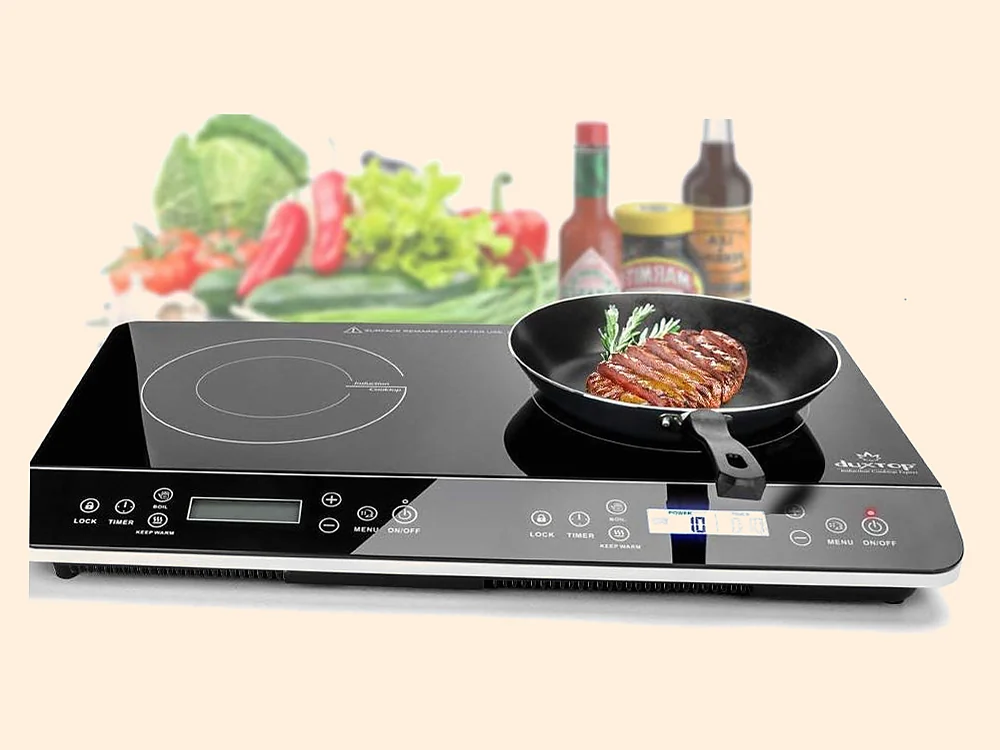
Induction sidesteps both problems. The magnetic field generated under the glass surface induces current directly inside the base of the pan itself: there's no flame spreading past the pan's edge and no intermediate coil losing heat to the air before it reaches the cookware. Nearly all the energy the cooktop draws goes directly into heating the pan and its contents. That's the core reason induction cooktops bring water to a boil faster on the same wattage: the energy simply isn't being lost along the way.
Instant response cuts waste too
Because the field can be adjusted or shut off instantly, there's no lingering heat still cooking (or burning) your food after you've turned the power down, unlike a coil that stays hot for a stretch after you dial it back. That responsiveness isn't just a convenience; it means less overcooking, less energy spent holding a pan at a higher temperature than necessary "just in case," and less heat radiating into your kitchen air that your air conditioning then has to work against in the summer.
What this means in practice
- Boiling and searing tasks generally finish faster at the same wattage, so total energy used per task tends to be lower.
- Kitchens run cooler during cooking, since less stray heat escapes into the room.
- Precise power and temperature presets mean less energy spent overshooting a target temperature and correcting for it.
- The tradeoff is the cookware requirement: a magnetic pan base is required to take advantage of any of this.
None of this makes induction a silver bullet; a well-maintained gas or electric setup is still perfectly usable. But if lower wasted energy and a faster, cooler cooking experience matter to you, the physics behind induction is doing real work, not just marketing.
See the cooktops built around this technology
Browse the full Duxtop induction cooktop lineup.
View the lineup